
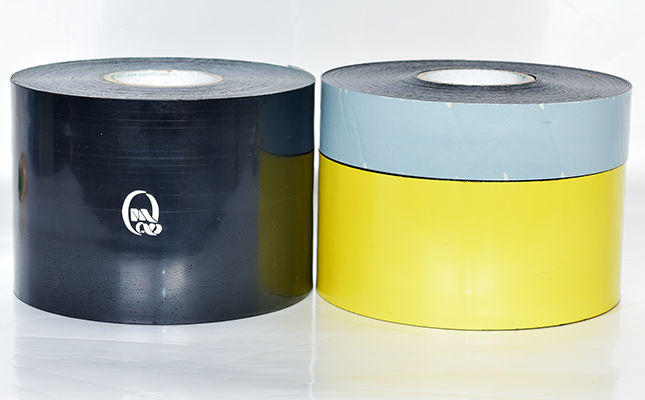
Polyethylene anti-corrosion tape is a commonly used cold wrapped anti-corrosion material in pipeline anti-corrosion engineering. With its unique structure (polyethylene substrate+butyl rubber/asphalt modified adhesive layer) and performance advantages, it is widely used in the anti-corrosion of buried pipelines, overhead pipelines, and irregular pipe fittings. The specific advantages are as follows:
Strong chemical stability: Polyethylene (PE) is an inert polymer material that is resistant to acid, alkali, salt spray, and soil corrosive media (such as groundwater and microbial secretions). It is not easy to react with common chemical substances and can effectively block the contact between pipelines and corrosive environments for a long time, protecting pipelines from chemical erosion.
Reliable sealing: The adhesive tape substrate has a certain degree of flexibility and can tightly adhere to the surface of the pipeline during winding construction. The adhesive layer (usually butyl rubber or pressure-sensitive adhesive) has strong viscosity and can fill small pits on the surface of the pipeline, reduce bubbles and gaps, achieve seamless coverage, prevent water and air infiltration, form a dense protective layer, and prevent corrosive media from entering the surface of the pipeline.
Good aging resistance: The butyl rubber layer is combined with polyethylene substrate, which has excellent heat aging resistance and UV resistance. By adding antioxidants, UV stabilizers and other additives, the weather resistance of the tape can be further improved. It is suitable for complex environments such as outdoor and underground, and the service life can usually reach 10-20 years.
Low operational threshold: No need for complex equipment and heating, can be constructed manually or with simple winding tools, can be directly wound on the surface of pipelines, supports mechanization or manual operation, has high construction efficiency, is suitable for rapid on-site operations, especially for small and medium-sized pipelines or on-site repair scenarios.
The requirements for pipeline surface are relatively flexible: compared with processes such as hot melt adhesive anti-corrosion coating, polyethylene anti-corrosion tape has slightly lower requirements for the flatness and dryness of the pipeline surface. As long as the pre-treatment reaches the basic rust removal level (such as Sa2 or St3), it can ensure the adhesion of the winding, reduce construction failures caused by improper base layer treatment, and reduce construction difficulty and cost.
Adapt to irregular structures: For irregular parts such as pipe bends, tees, flanges, etc., tape can be tightly wrapped by cutting, stacking, and wrapping to avoid "dead corners" in anti-corrosion due to complex structures. Traditional anti-corrosion coatings (such as paint) are prone to sagging and uneven thickness at irregular parts.
Adapt to complex environments: Construction can be carried out within a wide temperature range of -30 ℃ to 70 ℃, and bonding strength can be ensured through heating in low-temperature environments, adapting to harsh weather conditions.
Controllable raw material cost: Polyethylene is a common polymer material with mature production technology. The unit price of adhesive tape is lower compared to high-end anti-corrosion materials such as epoxy powder and polyurea, making it particularly suitable for cost control in large-scale pipeline anti-corrosion projects.
Easy maintenance in the later stage: If there is partial damage, the corresponding size of tape can be directly cut for local repair, without the need for overall rework. The maintenance cost is low and does not affect the normal operation of the pipeline.
Easy to calculate usage and minimal waste: The amount of tape used can be accurately calculated based on the diameter, length, and number of winding layers (usually 1-3 layers) of the pipeline (such as estimated by the pipeline surface area+overlap amount), with no significant material loss during construction, further reducing material costs.
Environmentally friendly and harmless: There is no solvent evaporation during the construction process, which meets environmental requirements and is an ideal choice to replace traditional polluting materials such as asphalt glass fiber cloth.
Balance of flexibility and impact resistance: Polyethylene substrate has high tensile strength, appropriate elongation at break, and can withstand slight deformation of the pipeline without breaking after winding. At the same time, it can withstand certain external impact and reduce anti-corrosion failure caused by mechanical damage.
Temperature resistance range suitable for conventional scenarios: Ordinary polyethylene anti-corrosion tape can adapt to temperature environments ranging from -20 ℃ to 60 ℃, meeting the needs of most civilian pipelines (such as water and gas pipelines) and general industrial pipelines; Some modified models (such as adding toughening agents) can broaden the temperature resistance range and cope with more extreme climates or medium temperatures.
The core advantage of polyethylene anti-corrosion tape lies in its comprehensive balance of "reliable anti-corrosion, flexible construction, and cost-effective". It is widely used in various scenarios such as oil, natural gas, chemical, and urban pipeline networks, especially for anti-corrosion projects in buried pipelines, municipal pipelines, and small and medium-sized industrial pipelines. It can meet different anti-corrosion level requirements through diversified specifications and is an ideal substitute for traditional anti-corrosion materials.
Get Your Custom Tape Solution?