
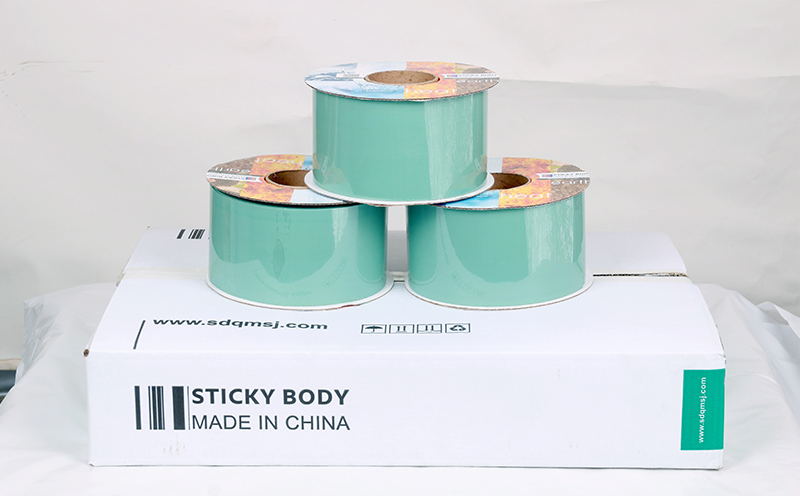
Viscoelastic anti-corrosion tape is a new and efficient anti-corrosion material, whose performance advantages stem from unique material properties, structural design, and the resulting multifunctional characteristics. The viscoelastic anti-corrosion tape is composed of uncured viscoelastic polymer as its core component, which distinguishes it from traditional cured anti-corrosion materials. Its molecular chain structure endows the material with cold flow characteristics - it can flow slowly at room temperature, automatically filling small defects (such as pinholes and cracks) in the anti-corrosion layer, forming a continuous and dense protective barrier. This dynamic sealing capability significantly improves the integrity of the anti-corrosion layer and avoids the risk of cracking caused by brittleness of traditional materials after curing.
The substrate of viscoelastic anti-corrosion tape is based on high polymer viscoelastic materials (such as butyl rubber, polyisobutene and other elastic modified materials), which have the following key characteristics:
Self repairing property: Molecular chains have high elasticity and fluidity, and can "self heal" through their own viscosity and elasticity after slight scratches or punctures. The material can penetrate into the gaps of irregular structures such as pipeline welds and flanges under pressure, automatically repairing construction damage or defects generated during operation, blocking the penetration paths of water, oxygen, and corrosive media.
Permanent adhesion: No need for heating or pressure, strong initial adhesion, can be directly adhered to the surface of various substrates such as steel, PE, PP, FBE, etc., without the need for primer, can closely adhere to metal surfaces (including rough and irregular surfaces) for a long time, and will not fall off even under temperature changes or vibration environments, forming a seamless sealing barrier.
Aging resistance: By adding antioxidants, UV absorbers, and other ingredients, it can resist the effects of sunlight, ozone, and temperature fluctuations (usually -30 ℃~80 ℃), maintain stable performance for a long time, and is not easily hardened, cracked, or flowed.
Long term effectiveness: Experimental data shows that its permeability is less than 0.01g/m ² · d, and its water peeling strength is over 0.2N/mm, which can completely isolate moisture and microbial corrosion. The design life is as long as 30-50 years.
Strong peel resistance: The peel strength is ≥ 2N/cm from -45 ℃ to the highest design temperature, ensuring a tight bond with the substrate even in extreme environments without the risk of detachment or cracking.
Temperature range: Suitable for temperatures ranging from -30 ℃ to 130 ℃, it maintains flexibility even in low temperature environments (-30 ℃) and can withstand 3% axial strain of pipelines. It is suitable for high strain scenarios such as frozen soil areas and directional drilling through sections.
Drip resistance: No drip for 48 hours at the maximum design temperature of+15 ℃ (≥ 80 ℃), ensuring the stability of the anti-corrosion coating in high temperature environments.
The tape forms a continuous "wet adhesive" sealing layer with the metal surface, which can completely isolate corrosive media such as moisture, oxygen, chloride ions, sulfides in the soil, and block the conditions for electrochemical corrosion from the source.
Some products add gas-phase corrosion inhibitors, which can form a molecular level protective film on the metal surface by volatilization. Even if there are small defects in the sealing layer, the corrosion inhibitor can diffuse to the exposed area and inhibit corrosion reactions.
The high elasticity of viscoelastic materials can absorb the deformation stress caused by temperature changes and foundation settlement in pipelines, avoiding damage to the anti-corrosion layer due to tension or compression, especially suitable for dynamic scenarios such as buried pipelines and vibrating equipment.
The requirements for grassroots treatment are relaxed (no need for sandblasting rust removal, manual rust removal to St2 level is sufficient), and can be directly wrapped without primer or heating. It can still be constructed normally in harsh environments such as humidity and low temperature, greatly improving efficiency, shortening construction period, and reducing labor costs. It can form a composite anti-corrosion system with outer protective tape (such as polypropylene PP tape) to further enhance the protective effect.
Excellent adhesion to irregular structures such as pipe bends, flanges, and valves, with no blind spots to cover, solving the problem of traditional anti-corrosion materials (such as coatings and glass cloth) being prone to leakage and warping at corners. Resistant to soil stress, seawater immersion, industrial waste gas, etc., widely used in strong corrosive environments such as underground pipelines, marine engineering, chemical equipment, etc.
The service life can reach more than 20 years, and if there is partial damage in the later stage, it can be directly repaired by stacking without the need for overall replacement, reducing maintenance cycles and costs. The material is solvent-free and complies with environmental standards such as RoHS and ISO 14001, making it harmless to construction personnel and the environment.
In summary, viscoelastic anti-corrosion tape has achieved an upgrade from passive barrier to active protection through multiple advantages of "material properties+anti-corrosion mechanism+construction adaptability". Especially in scenarios with high requirements for anti-corrosion life and construction convenience, its performance is significantly better than traditional anti-corrosion materials.
Get Your Custom Tape Solution?