
Corrosion is one of the leading causes of premature failure in pipelines, storage tanks, valves, and vital steel infrastructure across global industries. Whether deployed in oil and gas transmission, municipal water networks, marine environments, or industrial processing facilities, choosing the correct corrosion protection materials is essential for maximizing operational asset lifespan and minimizing maintenance overheads.
Selecting the right protection system begins with understanding the various anti corrosion tape types available on the market. With numerous anti corrosion tape types available, choosing the right solution can be challenging. Each tape is engineered with different materials and performance characteristics, making it suitable for specific environments and applications.
This guide explains the four most widely used anti corrosion tape types—PE, PVC, Butyl, and Petrolatum—compares their advantages, and helps you determine the best solution for your project.
Not all industrial corrosion environments share the same characteristics or present identical failure risks. For instance, a transmission pipeline buried deep underground encounters severe soil chemistry, moisture loading, and localized mechanical backfill stresses that differ entirely from the conditions faced by an offshore marine platform or above-ground industrial processing piping.
Failure to account for environmental variables such as soil resistivity, chemical exposure, ambient operating temperatures, and ultraviolet radiation can result in severe engineering consequences, including:
Understanding the distinct mechanical and chemical profiles of available anti corrosion tape types empowers engineers, procurement specialists, and asset owners to engineer robust, environment-specific defense strategies.
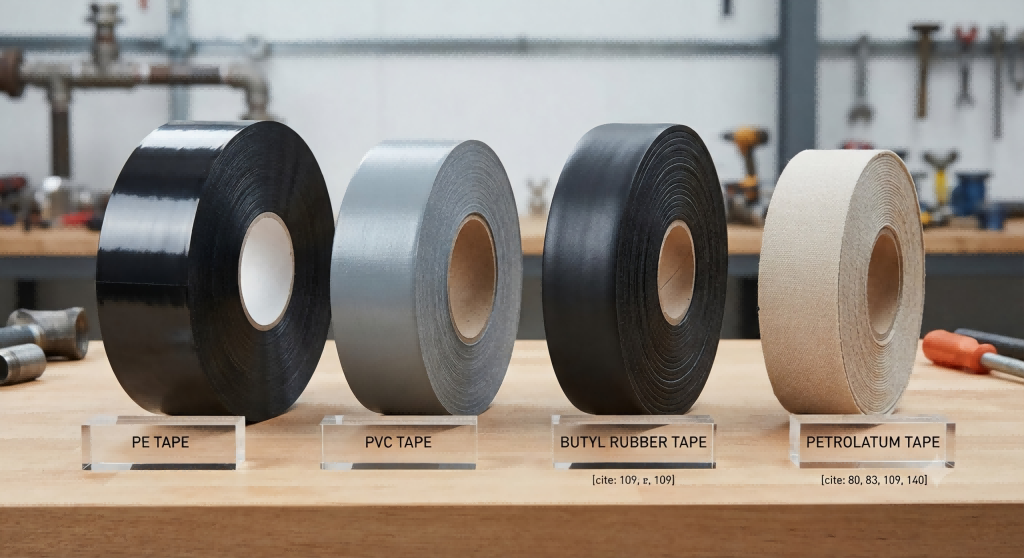
When evaluating industrial pipe wrapping materials, four primary polymer and chemical systems dominate engineering specifications worldwide, each offering unique advantages.
PE anti corrosion tape stands as one of the most widely specified pipeline wrapping solutions across the heavy oil, gas, and municipal water utilities sectors. Typically engineered as a multi-layer composite system, PE anti corrosion tape pairs a tough, high-tensile polyethylene backing with a high-performance adhesive layer, commonly formulated from butyl rubber. This synergistic design delivers exceptional resistance to impact, high tensile loads, and aggressive chemical degradation, making it an optimal selection for anti corrosion tape for underground pipelines.
When analyzing the difference between PE and PVC anti corrosion tape, engineers generally find that PE systems provide superior mechanical rigidity, puncture resistance, and long-term film durability, making them ideal for heavy-duty, long-distance underground transmission lines.
PVC anti corrosion tape offers exceptional flexibility, reliable moisture barrier performance, and outstanding electrical insulation properties, serving as a versatile asset for both utility conduit protection and general industrial piping. Compared to its polyethylene counterpart, PVC anti corrosion tape is frequently favored during manual field installations due to its superior conformability around tight radiuses, complex angles, and varying pipe configurations. While PE targets high-stress mechanical environments, PVC tape is often selected as a balanced, cost-effective solution for standard above-ground or light industrial wrapping requirements.
Butyl anti corrosion tape relies on a high-tack, pressure-sensitive rubber compound that excels by delivering immediate, aggressive adhesion and superior joint sealing. Rather than depending exclusively on thick backing layers for protection, butyl systems create an immediate, watertight bond that effectively conforms to complex surface irregularities, weld seams, and pipe fittings. This adaptability prevents the formation of localized "pinhole" corrosion that frequently initiates beneath rigid or poorly conformed coatings. Furthermore, because high-grade butyl rubber retains elasticity over extended periods, it easily accommodates thermal expansion, contraction, and operational vibrations.
Petrolatum tape is a specialized, non-hardening corrosion protection system manufactured from saturated petroleum waxes, active corrosion inhibitors, and a flexible reinforcing fabric carrier. Unlike conventional adhesive-backed wraps, petrolatum tape remains permanently soft and pliable throughout its entire operational lifecycle, allowing the compound to continuously creep and actively displace residual moisture on damp metal substrates. This unique displacement capability makes petrolatum tape widely recognized as the best anti-corrosion tape for marine environments, splash zones, offshore platform risers, and complex geometries like flanges and valves where traditional dry-surface application methods fail.
Knowing how to choose anti corrosion tape successfully requires a comprehensive evaluation of site-specific operating parameters rather than simply opting for the thickest or highest-tensile material available.
Across diverse heavy industrial sectors, these advanced wrapping materials safeguard essential capital assets:
Understanding the distinct mechanical properties of various anti corrosion tape types is essential for engineering a reliable, long-lasting corrosion management strategy. Because each material is purposefully designed to excel under specific environmental parameters, selecting the optimal tape ensures maximum structural integrity, minimized maintenance expenditure, and extended asset longevity.
Protect Your Pipelines with Quanmin Plastic
Whether your project requires specialized anti corrosion tape for underground pipelines, demanding offshore installations, or complex industrial piping networks, Quanmin Plastic delivers an extensive portfolio of high-performance corrosion protection materials engineered for extreme operating environments.
Our comprehensive manufacturing capabilities cover advanced PE, PVC, Butyl, and Petrolatum anti corrosion tape systems designed to meet rigorous international standards across the oil and gas, municipal water, and petrochemical industries.
Contact Quanmin Plastic today to consult with our technical specialists, review your exact project specifications, and source the ideal pipeline protection solution for your next infrastructure build.
Get Your Custom Tape Solution?