
Effective pipeline corrosion protection requires more than applying a protective coating. The selected system must match the pipeline environment, operating conditions, surface geometry, mechanical stresses, and installation requirements. If these factors are overlooked, moisture penetration, adhesion problems, coating damage, and premature corrosion can increase maintenance requirements and reduce asset service life.
Choosing the right anti corrosion tape for pipelines therefore involves more than comparing tape materials. This guide explains the key factors affecting pipeline tape selection, compares common tape options, and provides practical guidance for oil and gas, municipal water, marine, and industrial pipelines.
A pipeline protection system must maintain effective coverage throughout its expected service environment. The selected pipe anti corrosion tape should provide an appropriate barrier between the steel surface and moisture, oxygen, chemicals, and other corrosion factors while remaining effective around joints, bends, fittings, and other vulnerable areas.
Tape selection also influences installation efficiency, inspection requirements, maintenance needs, and the long-term reliability of the pipeline. For this reason, the best choice should be based on the complete application rather than material type or purchase price alone.
Before selecting anti corrosion tape for pipelines, evaluate the following conditions.
The installation environment is one of the most important selection factors. Buried pipelines may be exposed to soil moisture, groundwater, aggressive ions, and mechanical stresses during backfilling. Above-ground pipelines may face rain, humidity, sunlight, temperature changes, and industrial contaminants.
Marine and offshore pipelines require particular attention to continuous moisture and salt exposure, while industrial process pipelines may encounter chemicals or elevated temperatures. The tape must be suitable for the specific environment in which the pipeline will operate.
Moisture can contribute directly to corrosion by enabling electrochemical reactions at the steel surface. Underground pipelines therefore require a protection system capable of maintaining an effective barrier against groundwater and soil moisture.
Soil chemistry should also be considered because different soil conditions can create different corrosion risks. Where persistent moisture or aggressive environments are present, the wrapping system should provide appropriate sealing and environmental resistance.
Operating temperature can affect tape flexibility, adhesion, and long-term performance. Consider normal operating temperatures as well as temperature fluctuations during operation, shutdown, transportation, and seasonal changes.
The selected tape should always be used within the manufacturer's specified application and service conditions rather than assuming that one product is suitable for every temperature range.
Buried pipelines can experience abrasion, impact, vibration, soil movement, and mechanical stress during installation and backfilling. The protective layer must be able to maintain continuous coverage under these conditions.
Where higher mechanical protection is required, PE anti corrosion tape may be considered when its barrier and mechanical characteristics are appropriate. However, the complete system, including surface preparation and installation, should be evaluated rather than relying on tape material alone.
Straight pipe sections are generally easier to wrap than weld joints, elbows, valves, flanges, and other irregular components. These areas require sufficient flexibility and conformability to maintain continuous protection.
For complex geometries, butyl anti corrosion tape or petrolatum tape may be considered where sealing and conformability are important. The final selection should reflect the specific pipe configuration and protection requirements.
Different materials provide different combinations of flexibility, sealing, environmental resistance, and mechanical protection. The objective is to match these characteristics with the pipeline's actual operating conditions.
PE anti corrosion tape can be considered where moisture and mechanical protection are important, particularly for buried steel pipelines exposed to soil and groundwater. It may also be suitable for long pipeline sections in oil and gas, water, and industrial infrastructure where durable external protection is required.
PVC anti corrosion tape provides flexibility for various general industrial and above-ground applications. It can be considered where the pipeline environment does not demand the same level of mechanical or environmental resistance required by more demanding buried applications.
Its flexibility can also support convenient application around certain pipe configurations.
Butyl anti corrosion tape is valued for its sealing and conformability. It can be considered for field joints, fittings, flanges, valves, and irregular surfaces where maintaining close contact with the substrate is important.
For complex pipe geometries, butyl-based solutions may form part of an overall corrosion protection system.
Petrolatum tape is a non-hardening protective material that can conform closely to pipe surfaces and irregular components. It may be considered for wet, humid, marine, and offshore environments, as well as valves, flanges, and other difficult-to-protect areas.
Its moisture-displacing characteristics can be relevant where persistent environmental moisture is a concern.
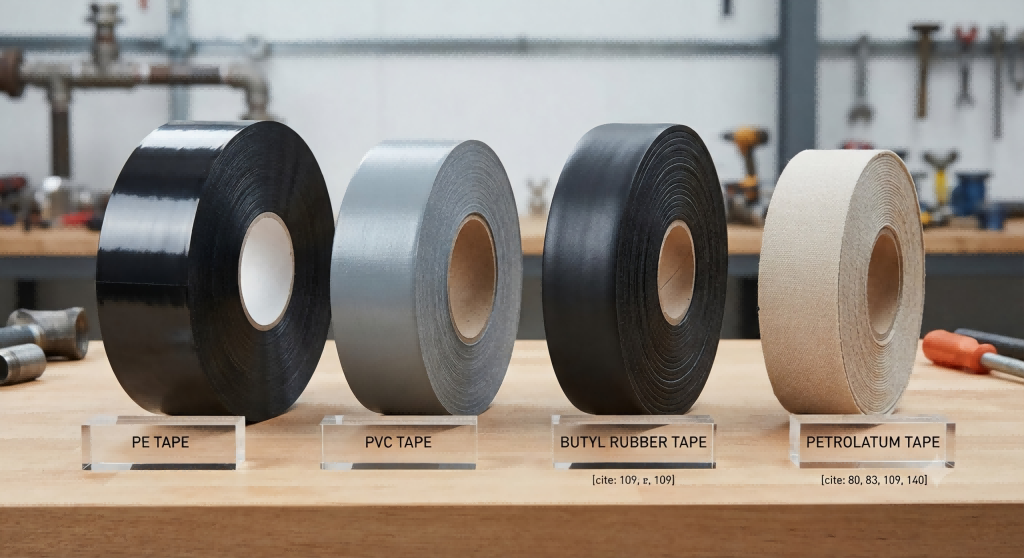
The following framework can help narrow the options according to common pipeline conditions:
|
Pipeline Condition |
Tape Type to Consider |
Primary Requirement |
|
Buried steel pipeline |
PE |
Moisture and mechanical protection |
|
General above-ground piping |
PVC |
Flexible general protection |
|
Field joints and irregular surfaces |
Butyl |
Sealing and conformability |
|
Marine or high-moisture environment |
Petrolatum |
Moisture protection and conformability |
|
Valves and flanges |
Butyl / Petrolatum |
Coverage of complex surfaces |
|
Oil and gas pipelines |
PE / Butyl system |
Long-term external protection |
|
Municipal water pipelines |
PE / suitable tape system |
Moisture and soil protection |
This table is a practical selection framework rather than a universal specification. Final requirements depend on the pipeline material, operating environment, installation method, project specifications, and manufacturer's recommendations.
When selecting anti corrosion tape for oil and gas pipelines, evaluate burial conditions, soil moisture, mechanical stresses, operating temperature, and the required protection system.
Long-distance pipelines may require a combination of corrosion resistance, mechanical protection, and reliable field application. PE-based systems can be considered for suitable buried sections, while more conformable materials may be useful around joints and complex components. Compatibility with an existing coating or primer system should also be confirmed where applicable.
For anti corrosion tape for municipal water pipelines, underground exposure and long-term external protection are important considerations. Water pipelines can encounter persistent soil moisture, groundwater, and mechanical stress during installation and backfilling.
A suitable pipeline wrapping tape system should maintain continuous external coverage, particularly around joints and other vulnerable areas. Project specifications and installation requirements should be reviewed before selecting the final system.
Marine environments expose pipelines to high humidity, water, salt, and potentially continuous wetting. Anti corrosion tape for marine pipelines should therefore be evaluated for moisture resistance, conformability, and long-term environmental exposure.
Petrolatum-based systems may be considered for certain marine components, particularly irregular surfaces, valves, and flanges. However, the complete corrosion protection system should be selected according to the specific application.
Industrial process pipelines may encounter chemicals, temperature fluctuations, abrasion, and other aggressive conditions. Selection should therefore consider chemical exposure, operating temperature, mechanical stress, and compatibility with the existing coating system.
For demanding applications, tape should be treated as part of a broader pipeline corrosion protection strategy rather than as an isolated product.
Even a properly selected pipeline wrapping tape can underperform if it is incorrectly installed. Surface preparation is particularly important because dirt, rust, oil, moisture, or loose coating can interfere with adhesion and create pathways for corrosion.
The pipe surface should be prepared according to the manufacturer's requirements, with primer applied where specified. During wrapping, maintain consistent tension and overlap to achieve continuous coverage, paying particular attention to welds, joints, bends, fittings, and transitions.
After application, inspect the completed system for gaps, wrinkles, exposed areas, and other installation defects before backfilling or commissioning. Proper preparation and application are essential parts of an effective protection system.
Several selection mistakes can reduce the effectiveness and lifecycle value of a pipeline protection system:
A successful selection process should therefore consider the entire protection system rather than focusing on one product characteristic.
Anti corrosion tape for pipelines is one of several approaches to external corrosion protection. Liquid coatings, factory-applied coatings, fusion-bonded epoxy systems, and multi-layer coating systems may also be selected depending on project requirements.
Tape systems can provide practical advantages for field application, repairs, joints, fittings, and maintenance, while factory-applied coatings may be preferred for controlled production environments and specific pipeline designs. The appropriate solution depends on project specifications, environmental conditions, installation requirements, and lifecycle considerations.
For a broader comparison of tape and conventional coating approaches, see our guide to Anti Corrosion Tape vs Paint vs Coatings.
Selecting the right anti corrosion tape for pipelines requires a practical assessment of the pipeline environment, moisture conditions, operating temperature, mechanical stress, pipe geometry, and installation method.
Quanmin Plastic provides anti-corrosion tape solutions for pipeline and industrial protection applications. Whether you are evaluating PE anti corrosion tape, PVC anti corrosion tape, butyl anti corrosion tape, or petrolatum tape, our team can help you assess application requirements and identify a suitable protection approach.
Contact Quanmin Plastic to discuss your pipeline corrosion protection requirements and find the right tape solution for your project.
Get Your Custom Tape Solution?